
Introduction
What Are the Main Garage Door Opener Types and Benefits for Homeowners?
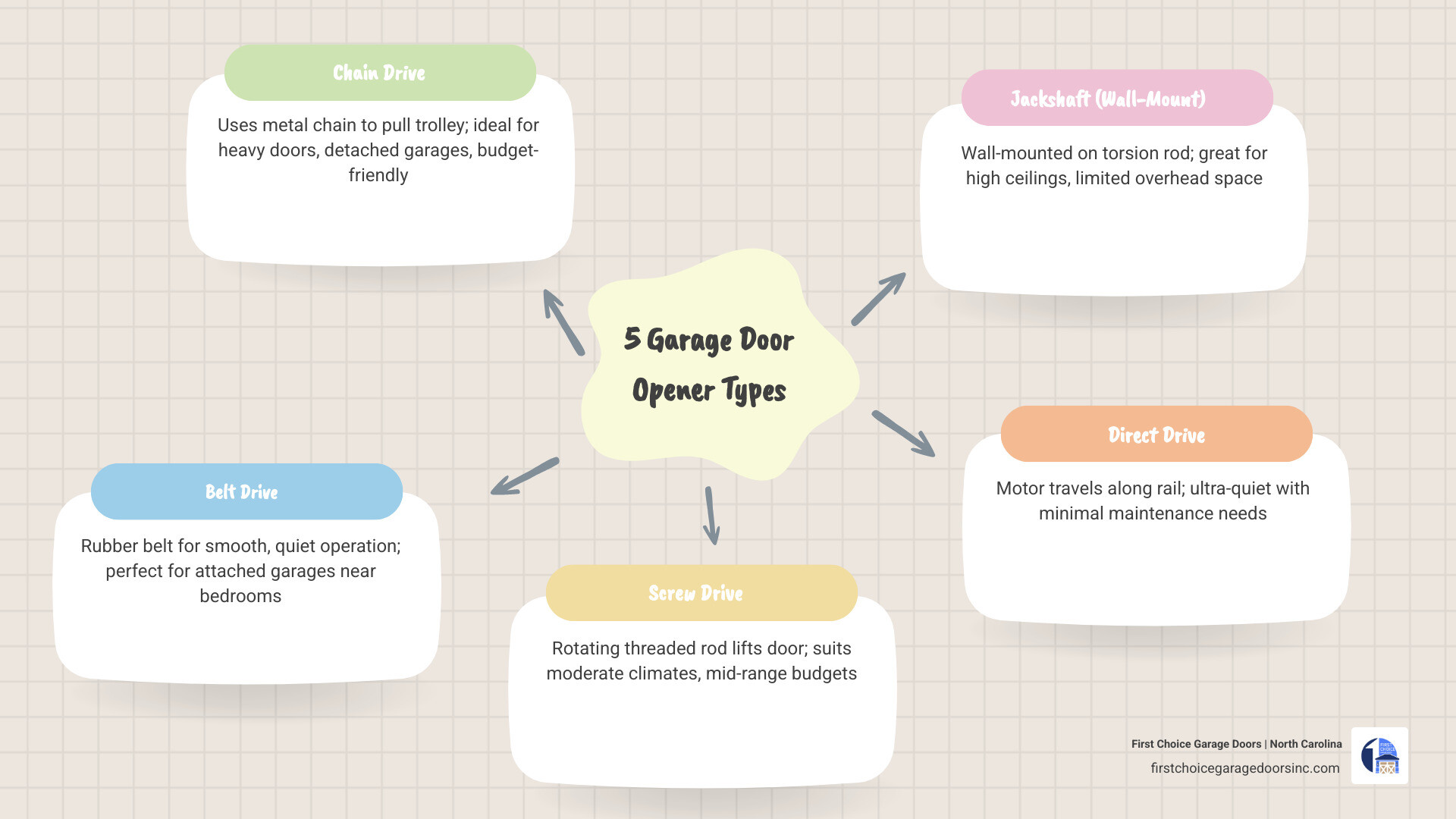
Understanding garage door opener types and benefits is one of the most practical things you can do before buying or replacing a system in your home. Here is a quick breakdown of the five main types and what each one offers:
| Opener Type | How It Works | Best For |
|---|---|---|
| Chain Drive | Metal chain pulls a trolley along a rail | Heavy doors, detached garages, budget buyers |
| Belt Drive | Rubber belt moves the trolley | Attached garages, quiet operation near bedrooms |
| Screw Drive | Threaded steel rod rotates to lift the door | Moderate climates, mid-range budgets |
| Jackshaft (Wall-Mount) | Mounts to the wall, drives the torsion rod directly | High ceilings, limited overhead space |
| Direct Drive | Motor travels along the rail itself | Ultra-quiet operation, low maintenance |
Most residential garage doors today come with automatic openers as a standard feature — but not all openers are built the same. The right choice depends on your garage layout, how close the space is to your living areas, and how much noise you are willing to tolerate. For homeowners in Fayetteville, NC, where attached garages are common and many families use the garage as a main entry point, these differences matter more than most people realize.
Chances are, you have not thought much about your garage door opener until it stopped working — or until a neighbor’s new system made yours sound like a freight train by comparison. Whether you are replacing an aging unit or setting up a new installation, knowing your options puts you in the driver’s seat.
I’m Tony Aguilar, founder of First Choice Garage Doors, Inc., with over 30 years of hands-on experience helping homeowners navigate garage door opener types and benefits to find the right fit for their specific needs. In the sections below, I will walk you through each opener type in plain language so you can make a confident, informed decision.
Understanding the Primary Garage Door Opener Types and Benefits
When we talk about 3 types of garage door openers, we are usually referring to the “trolley” style systems that sit in the center of your garage ceiling. However, as of May 2026, the market has expanded to include several specialized designs that solve specific architectural problems.
The primary benefit of any modern opener is convenience. Gone are the days of stepping out into a North Carolina thunderstorm to heave a heavy door open by hand. Beyond simple lifting, today’s openers provide security, lighting, and even package delivery integration. When comparing drive chain belt drive doors, the decision often comes down to the “Three Cs”: Cost, Clatter, and Care.
Chain, Belt, and Screw Drive Mechanisms
Chain Drive Openers This is the “old reliable” of the industry. It uses a metal chain—very similar to a bicycle chain—to pull the trolley along a rail.
- The Good: They are incredibly durable and generally the most affordable option. They have the strength required for heavy, oversized, or wooden doors.
- The Bad: They are noisy. The metal-on-metal contact creates a vibration that can be felt through the walls. If your garage is detached, this isn’t an issue. If your bedroom is above the garage, you might want to reconsider.
Belt Drive Openers Instead of a chain, these use a steel-reinforced rubber belt.
- The Good: They are virtually silent. This makes them the gold standard for attached garages. They also require less maintenance because there is no metal chain to lubricate.
- The Bad: They typically carry a higher price tag than chain drives.
Screw Drive Openers These use a threaded steel rod to move the trolley.
- The Good: With fewer moving parts than a chain or belt system, they are theoretically very reliable. They offer a smooth opening speed.
- The Bad: They can be sensitive to extreme temperature shifts. While Fayetteville has a generally moderate climate, those rare freezing winter nights can cause the lubricant on the screw to stiffen, leading to more noise or slower operation.
Many homeowners find that why your home needs a wifi garage door opener is less about the drive type and more about the connectivity, but the drive mechanism remains the “muscle” of the operation.
Jackshaft and Direct Drive Innovations
If you have a unique garage layout, you might need to look beyond the standard ceiling rail.
Jackshaft (Wall-Mount) Openers These units mount on the wall beside the garage door and connect directly to the torsion rod. This is a game-changer for garages with cathedral ceilings or those where the homeowner wants to use the ceiling for high-clearance storage or a car lift. They require about seven inches of side clearance and three inches of clearance above the torsion rod. Because they don’t use a rail, they eliminate the vibration associated with overhead units, making them incredibly quiet.
Direct Drive Openers In a direct drive system, the motor itself is the trolley. It travels along a stationary chain or belt. Since the motor is the only moving part, these are often cited as the quietest and most durable garage door openers available in 2026. They offer a sleek look and minimal maintenance requirements.
Key Performance Factors: Horsepower and Safety Standards
Choosing the right drive type is only half the battle; you also need to ensure the motor has enough “oomph” to do the job without burning out.
The Advantages of Smart Garage Door Opener Types and Benefits
In 2026, smart garage door openers are no longer a luxury—they are the standard. Most modern units come with built-in Wi-Fi that connects to a smartphone app.
There are three benefits of installing a new wifi garage door opener that our customers in Fayetteville mention most often:
- Remote Monitoring: Ever get halfway to work and wonder if you closed the door? You can check and close it from your phone.
- Amazon Key Integration: You can grant temporary access to delivery drivers so packages stay safe inside your garage rather than sitting on the porch.
- Battery Backup: Many smart openers include a battery backup that can operate the door for 10 to 20 cycles during a power outage—a lifesaver during hurricane season.
Maintenance and Longevity of Garage Door Opener Types and Benefits
The average garage door opener lasts between 10 and 15 years. However, its lifespan depends heavily on how well it is maintained.
- Chain and Screw Drives: These require regular lubrication with a lithium-based grease to keep the metal parts moving smoothly.
- Belt Drives: These require very little maintenance, though you should still inspect the belt for fraying every year.
- Balance Testing: No matter the opener type, if your garage door is out of balance, the motor will work twice as hard and fail early. You should be able to lift your door halfway by hand and have it stay in place. If it slams down or flies up, your springs need professional adjustment.
Knowing when you should get a new garage door opener often comes down to the frequency of repairs. If you find yourself calling for service every few months, an upgrade is likely a wiser investment.
Selecting the Right Opener for Your Fayetteville Home
When picking the best garage door opener for your home, we always tell our neighbors to look at their garage’s physical environment. Is there a nursery directly above the garage? Go with a belt drive. Do you have a heavy, custom wood door? You’ll likely need a high-horsepower chain drive.
We believe why a garage door opener is a wise investment is because it protects the most expensive moving part of your home—the garage door itself. A smooth-running opener prevents the door panels from jerking and warping over time.
Matching Horsepower to Your Door Weight
Horsepower (HP) is the rating of the motor’s lifting capacity.
- 1/2 HP: This is the standard for most single-car and double-car sectional aluminum doors. It provides enough power for daily use without excessive energy consumption.
- 3/4 HP to 1 1/4 HP: We recommend these higher ratings for heavily insulated doors, wind-load rated doors (common in coastal-adjacent NC), or oversized wooden doors.
Using an underpowered motor is a recipe for disaster; it will strain the internal gears and likely fail within a few years. On the flip side, factors to consider when selecting your garage door opener include the risk of “over-powering.” A motor that is too strong for a very light door can actually cause the door to move too fast, potentially leading to structural damage.
Essential Safety Features for Modern Openers
Safety is not optional. Why are garage door openers important? Because they act as a security gate for your home.
Since January 1, 1993, federal law has required all garage door openers to be equipped with safety sensors (often called photo-eyes). These sensors sit about six inches off the ground and send an invisible beam across the opening. If that beam is broken while the door is closing, the door will automatically reverse.
Modern units also feature “rolling code” technology. Every time you press your remote, the opener generates a brand-new, encrypted code. This prevents tech-savvy thieves from “grabbing” your signal to open the door later. If your current opener was made before 1993, why you should get an upgrade to your garage door opener is simple: your family’s safety.
Frequently Asked Questions
Which garage door opener type is the quietest for attached garages?
Belt drive and direct drive openers are the quietest. Belt drives use a flexible rubber belt that absorbs vibration, while direct drive motors have only one moving part, eliminating the “clanking” sound of chains and rails. Jackshaft openers are also excellent for noise reduction because they remove the overhead rail entirely. This is one of the top smart garage door opener benefits for homeowners who hate getting out of the car in the middle of the night—you won’t wake up the whole house when you arrive home.
How much horsepower does a double-car garage door require?
For a standard double-car aluminum or steel door, a 1/2 HP motor is usually sufficient. However, if your door is heavily insulated or made of solid wood, we strongly recommend a 3/4 HP motor to ensure longevity and smooth operation.
Can I add smart features to an existing garage door opener?
Yes! If your current opener is in good mechanical shape but lacks Wi-Fi, you can often buy a “smart garage hub” or retrofit kit. These devices connect to your existing motor and allow you to control the door via a smartphone app.
Conclusion
At First Choice Garage Doors, we know that choosing between the various garage door opener types and benefits can feel overwhelming. Whether you need the brute strength of a chain drive for a commercial warehouse or the whisper-quiet performance of a belt drive for your family home in Fayetteville, we are here to help.
Our team prioritizes your safety and satisfaction, ensuring every installation meets the highest industry standards. If you are ready to upgrade your “unsung hero” of a garage door opener, or if you simply have questions about which motor is right for your door, don’t hesitate to reach out.
For expert advice or to schedule an installation, visit our Garage Door Openers Contact page today. We look forward to helping you find the perfect fit for your North Carolina home!